- +91 7302256783
- cohibapharma@gmail.com

ISO & GMP-WHO Certified Pharma Companies in India: Why Certification Should Be Your First Filter in 2026
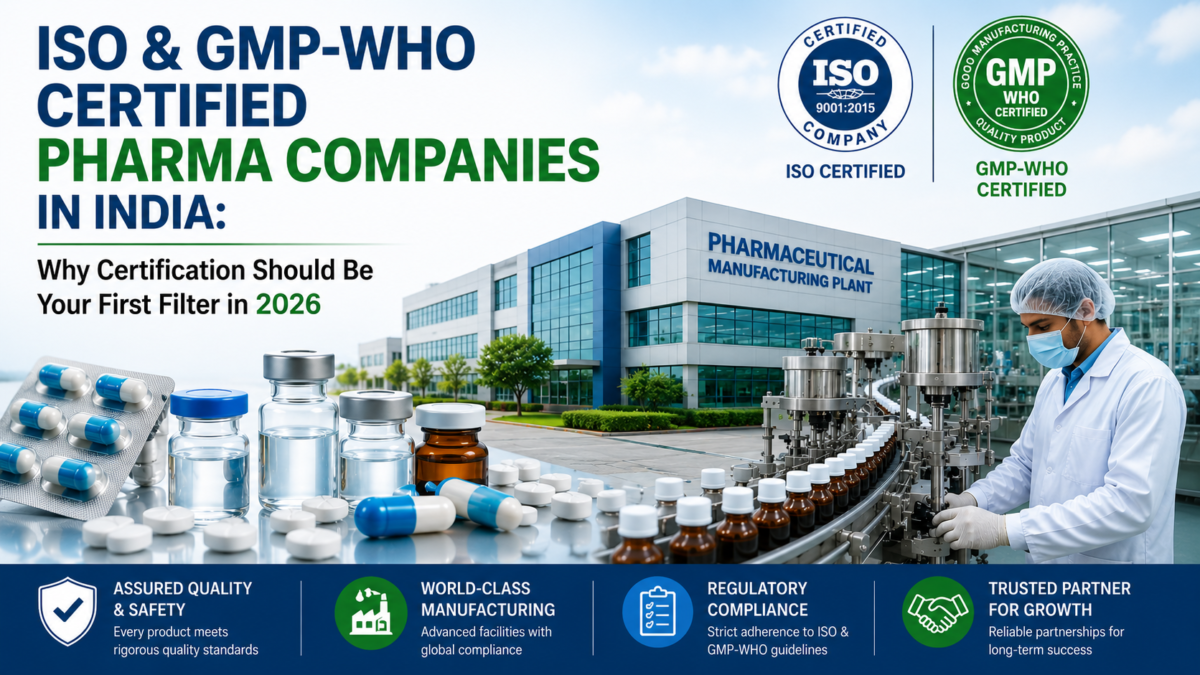
If you’ve spent any time searching for a pharma franchise partner or a bulk medicine supplier, you’ve probably run into the same two acronyms over and over: ISO and GMP-WHO. They show up on almost every pharma company’s homepage, often right next to the logo.
But here’s the real question most people don’t stop to ask: what do these certifications actually guarantee, and why should they influence your decision?
In an industry where the product being manufactured directly affects human health, certification isn’t a marketing badge. It’s the difference between a company that follows documented, auditable quality processes and one that doesn’t. This becomes even more important in 2026, as India’s pharmaceutical regulatory framework has tightened significantly under the Revised Schedule M rules, pushing manufacturers closer to global GMP standards than ever before.
This guide breaks down what ISO and WHO-GMP certifications mean, why they matter, and how to identify genuinely certified pharma companies in India including what to look for before signing on with a franchise partner or supplier.
What Does ISO Certification Mean for a Pharma Company?
ISO (International Organization for Standardization) certification confirms that a company follows internationally recognized standards for quality management, consistency, and process control.
For pharmaceutical companies, the most relevant ISO standards include:
| ISO Standard | What It Covers |
| ISO 9001:2015 | Quality Management Systems (QMS) |
| ISO 13485:2016 | Medical Devices Quality Management |
| ISO 14001:2015 | Environmental Management |
| ISO 22000:2018 | Food Safety (relevant for nutraceuticals) |
An ISO-certified pharma company has documented, repeatable processes for everything from raw material sourcing to final packaging and is subject to periodic external audits to keep that certification valid.
What Is WHO-GMP Certification, and Why Does It Matter More?
GMP-WHO (Good Manufacturing Practices, as defined by the World Health Organization) is a step above general quality certification. It’s specific to pharmaceutical manufacturing and is issued in India by the CDSCO (Central Drugs Standard Control Organisation) after a physical factory inspection.
In simple terms: an ISO certificate tells you a company manages quality well. A WHO-GMP certificate tells you the company’s actual manufacturing facility its cleanrooms, equipment, documentation, and staff training has been inspected and approved against WHO’s Technical Report Series (TRS) guidelines.
How a Company Gets WHO-GMP Certified in India
- Gap assessment against current WHO GMP guidelines (TRS 1010)
- Preparation of the Site Master File, SOPs, and validation documentation
- Application submitted through CDSCO’s SUGAM portal
- On-site factory inspection by CDSCO officials
- Response to inspector observations (minor, major, or critical) with corrective action
- Certificate issued typically valid for three years, subject to renewal and re-inspection
This isn’t a one-time paperwork exercise. It’s a recurring commitment to maintaining standards, which is exactly why it carries weight with regulators, doctors, and international buyers.
Why 2026 Is a Turning Point for Pharma Compliance in India
India’s regulatory environment has shifted meaningfully in the last two years. The Revised Schedule M, notified in January 2024, brought Indian GMP requirements much closer to WHO-GMP, EU-GMP, and USFDA benchmarks.
Key changes reshaping the industry this year:
- Structured Pharmaceutical Quality Systems (PQS) are now mandatory, not optional
- Data integrity requirements now follow ALCOA+ principles, with computerised systems compliance similar to 21 CFR Part 11
- Risk-based inspections are becoming the norm, aligning Indian audits with international regulatory practice
- Non-compliant manufacturers now face real consequences show-cause notices, licence suspension, and product recalls, with remediation costs often running into crores
What this means practically: the gap between a genuinely certified pharma company and one that simply claims certification is widening. Buyers and franchise partners who don’t verify credentials properly are taking on more risk than they might realize.
Why Certification Should Be Your First Filter Not an Afterthought
1. It Protects Patient Safety
Every certified process from raw material testing to batch documentation exists to catch problems before a product reaches a patient. This isn’t bureaucracy; it’s the mechanism that prevents contamination, dosage errors, and stability failures.
2. It Signals Long-Term Business Stability
Companies that invest in ISO and WHO-GMP certification are demonstrating a commitment to staying in business long-term. Certification requires ongoing investment in infrastructure, documentation, and training something short-term operators tend to skip.
3. It Opens Export and Institutional Markets
A WHO-GMP certificate is recognized in over 100 countries. If you’re partnering with a company for franchise or distribution, this credential often signals that the manufacturer has ambitions and capability beyond the domestic market.
4. It Reduces Franchise Partner Risk
For PCD pharma franchise partners specifically, working with a certified company means fewer regulatory headaches, more consistent product quality, and a lower chance of facing recalls or compliance issues that could damage your reputation in the local market.
How to Verify a Pharma Company’s Certifications Before Partnering
Don’t take a logo on a website at face value. Here’s what to actually check:
- Ask for the certificate number and cross-check it against the certifying body’s records
- Confirm the certificate is current WHO-GMP certificates typically expire every three years
- Check CDSCO’s records for the manufacturing licence and inspection history where available
- Visit the facility if possible, or request recent third-party audit reports
- Look for consistency between the company’s claimed certifications and its product range a company making injectables, for instance, should have facility-specific approvals for sterile manufacturing
Cohiba Pharmaceuticals: Certified Quality, Built for Long-Term Partnerships
At Cohiba Pharmaceuticals, based in Dehradun, Uttarakhand, certification isn’t treated as a checkbox, it’s built into how we operate. As an ISO-certified and GMP-WHO approved pharmaceutical company, we manufacture tablets, syrups, dry syrups, capsules, injectables, and powders using premium raw materials and clinically tested formulations.
We’re recognised as one of the fastest-growing PCD Pharma Franchise providers in Dehradun, and our approach is straightforward: combine certified manufacturing standards with a strong distribution network, so our franchise partners can build their business on a foundation they don’t have to worry about.
Expert Insight
“In pharma, certification isn’t the finish line it’s the minimum starting point for trust. The companies that treat it that way, rather than as a marketing checkbox, are usually the ones still standing five years from now.” Industry perspective, Cohiba Pharmaceuticals
Conclusion
ISO and WHO-GMP certifications aren’t just credentials to glance past on a company’s About page. They represent audited, documented commitments to quality, safety, and consistency and in 2026’s tightened regulatory environment, that distinction matters more than ever.
Whether you’re a healthcare provider sourcing medicines, a distributor, or someone exploring a PCD pharma franchise opportunity, making certification your first filter not your last check will save you from avoidable risk down the line.
FAQs
- What is the difference between ISO and WHO-GMP certification?
ISO certification confirms a company follows international quality management standards across its operations. WHO-GMP certification is pharma-specific and confirms the actual manufacturing facility has passed a physical inspection against WHO’s manufacturing guidelines. - How long is a WHO-GMP certificate valid in India?
A WHO-GMP certificate issued by CDSCO is typically valid for three years, after which the facility must undergo re-inspection for renewal. - Why does WHO-GMP certification matter for a PCD pharma franchise?
It ensures the products you’re distributing meet consistent, audited quality standards reducing the risk of recalls, compliance issues, or reputational damage in your local market. - How can I verify if a pharma company is genuinely certified?
Ask for the certificate number, confirm it’s current, check CDSCO records where available, and consider requesting recent audit documentation or a facility visit. - Is Cohiba Pharmaceuticals ISO and GMP-WHO certified?
Yes. Cohiba Pharmaceuticals is an ISO-certified and GMP-WHO approved pharmaceutical company based in Dehradun, Uttarakhand, manufacturing tablets, syrups, capsules, injectables, and more.